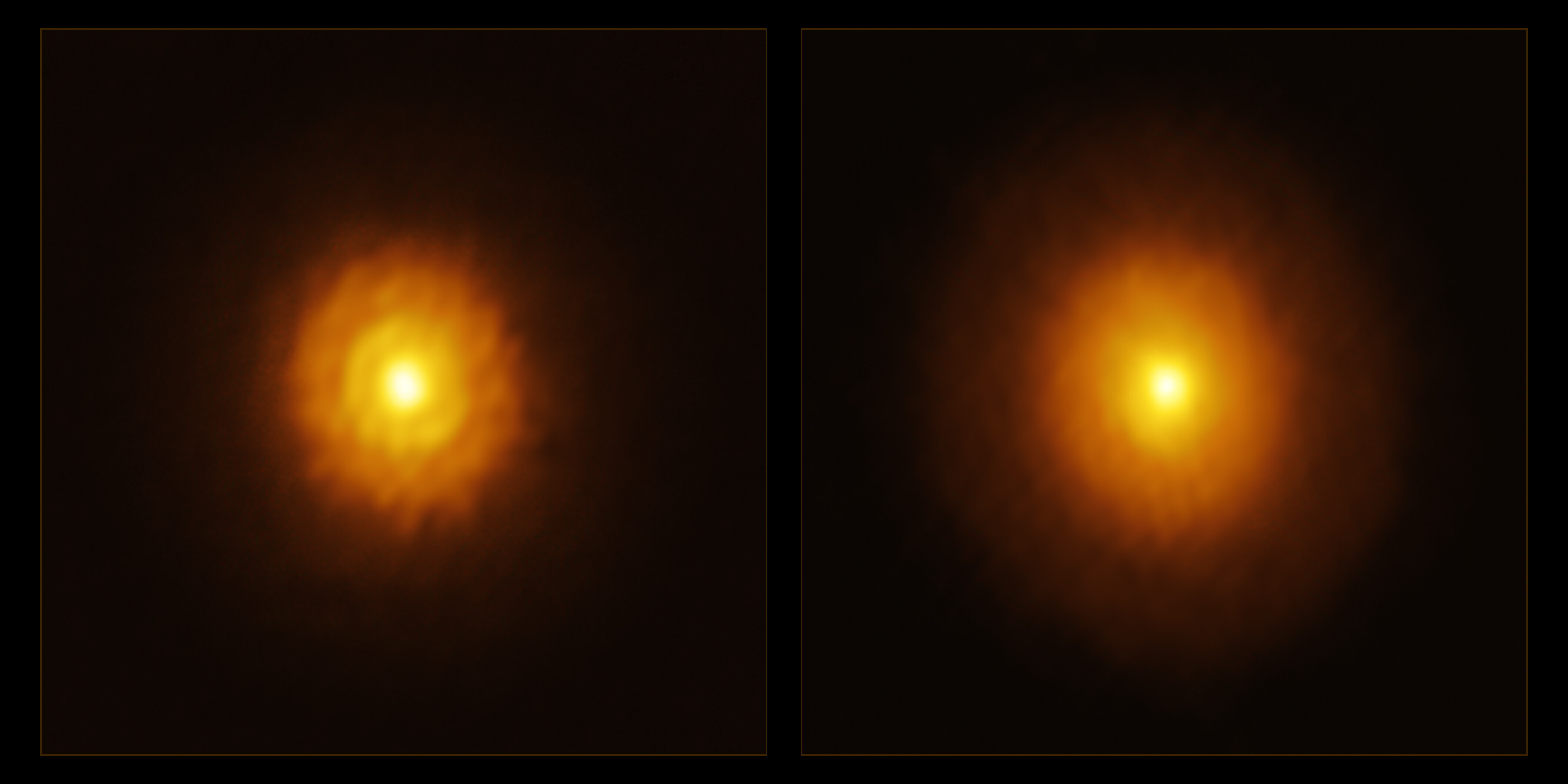
Astronomers have detected silicon sulfide isotopologues — ²⁸SiS and ³⁰SiS — in the protoplanetary disk around PDS 66 (MP Mus) at 5σ–6σ significance using ALMA. The emission is compact, located ~60 au from the star in the southwestern part of the disk, and its kinematics are consistent with Keplerian rotation — pointing to a protoplanetary origin. The estimated SiS mass of 10²²–10²³ g accounts for at least 10% of the silicon locked in local dust grains.
Concentrating this much silicon in the gas phase through local sublimation alone is physically implausible. The favored explanation is a low-mass protoplanet surrounded by a circumplanetary envelope, where infalling pebbles sublimate upon accretion and release silicon into the gas. If confirmed, this would be a direct chemical fingerprint of a planet actively forming right now.