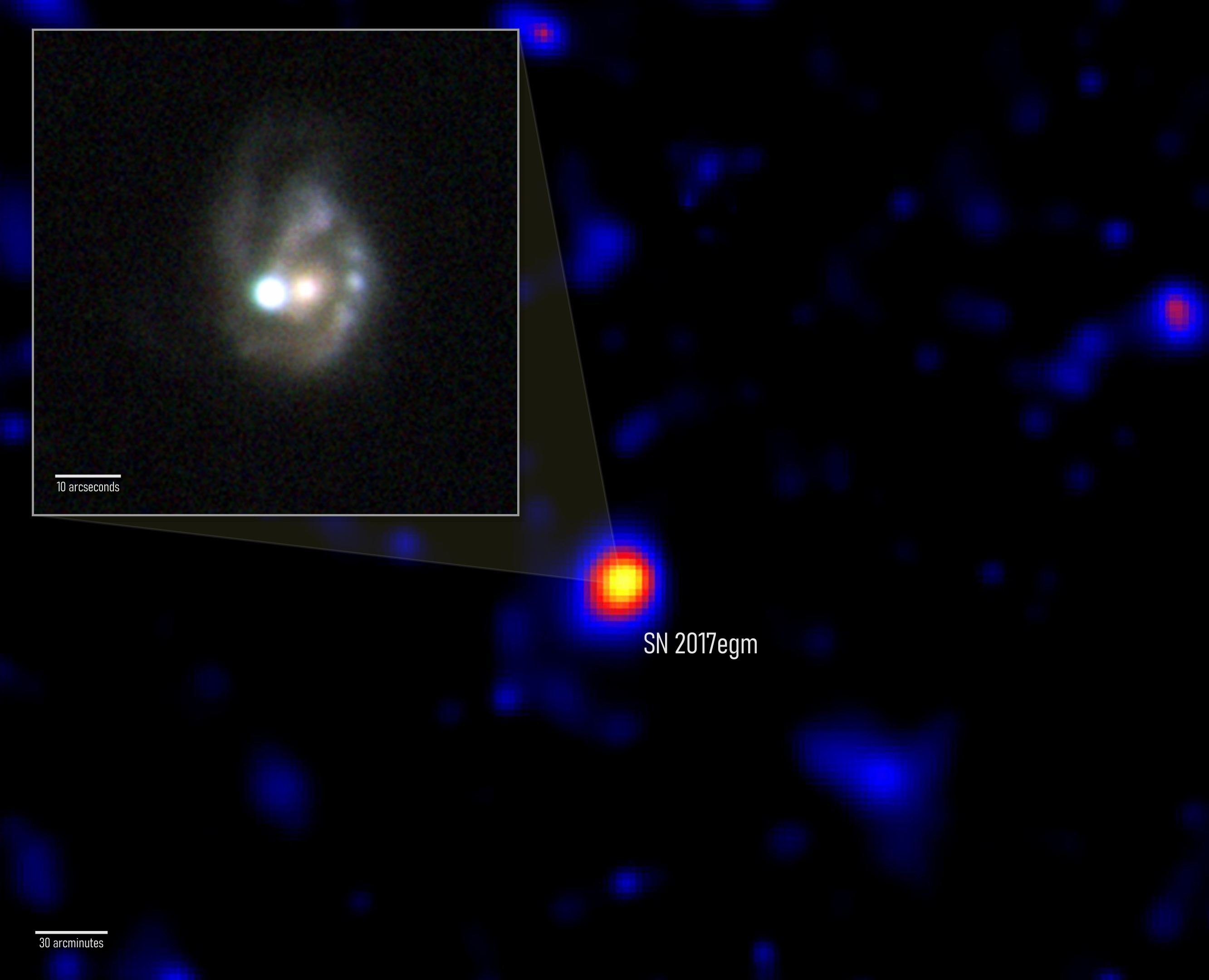
For nearly 20 years, astronomers searched for gamma-ray signals from supernovae in data from NASA's Fermi Space Telescope. There were hints, but nothing definitive — until now. An international team has confirmed that Fermi detected gamma-ray emission from a rare superluminous supernova, SN 2017egm. The results are published in Astronomy & Astrophysics.
SN 2017egm exploded in galaxy NGC 3191, about 440 million light-years away in the constellation Ursa Major. It's one of the nearest superluminous supernovae known — explosions that produce 10+ times more visible light than normal. Around 400 such events have been identified over the past two decades, but what gives them that extra power remained an open question.
The most likely answer: a magnetar. That's a neutron star with an extreme magnetic field — 1,000 times stronger than typical neutron stars and 10 trillion times stronger than a fridge magnet. A newborn magnetar spins hundreds of times per second, driving a powerful outflow of electrons and positrons. These particles form a cloud — a magnetar wind nebula — where gamma rays interact repeatedly with the supernova debris. Unable to escape directly, the gamma radiation gets reprocessed into visible light, giving the supernova its extra luminosity boost.
About three months after the collapse, as the debris expands and cools, gamma rays begin leaking out — and that's exactly what Fermi detected.
A new ground-based facility, the Cherenkov Telescope Array, will be able to detect similar events out to about 500 million light-years.