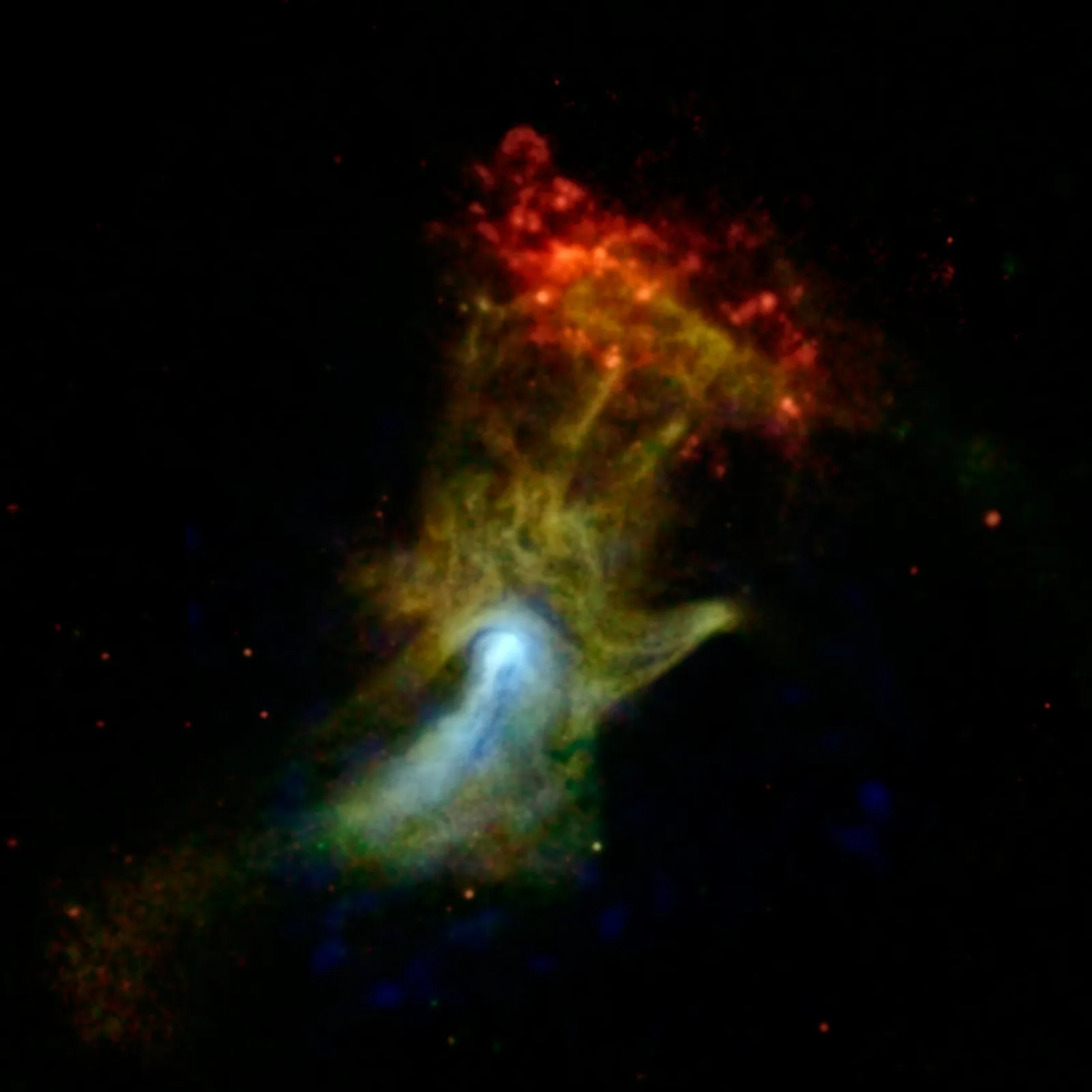
A neutron star spins and releases a stream of charged particles — the so-called pulsar wind. When this wind collides with its surroundings, it forms a pulsar wind nebula (PWN). Studying these objects reveals the physics of neutron star magnetospheres and ultra-relativistic outflows.
Radio observations play a key role here. Researchers stress that spatially-resolved maps of the continuum and polarized radio emission of such sources are needed to understand how electron-positron pairs are born in neutron star magnetospheres.
These particles are accelerated to enormous energies — above 10^15 electronvolts. For comparison, that is roughly a hundred thousand times more than the energies reached at the Large Hadron Collider. The authors suggest that alongside electrons and positrons, baryons (heavy particles such as protons) may also be accelerated. Observations should show how these particles propagate inside the nebula and into the surrounding interstellar medium.
This is where the future radio telescope SKA (Square Kilometre Array) comes in. Its sensitivity, dynamic range, and timing precision significantly surpass existing instruments. It could help clarify the origin of some of the highest-energy particles produced in our Galaxy.