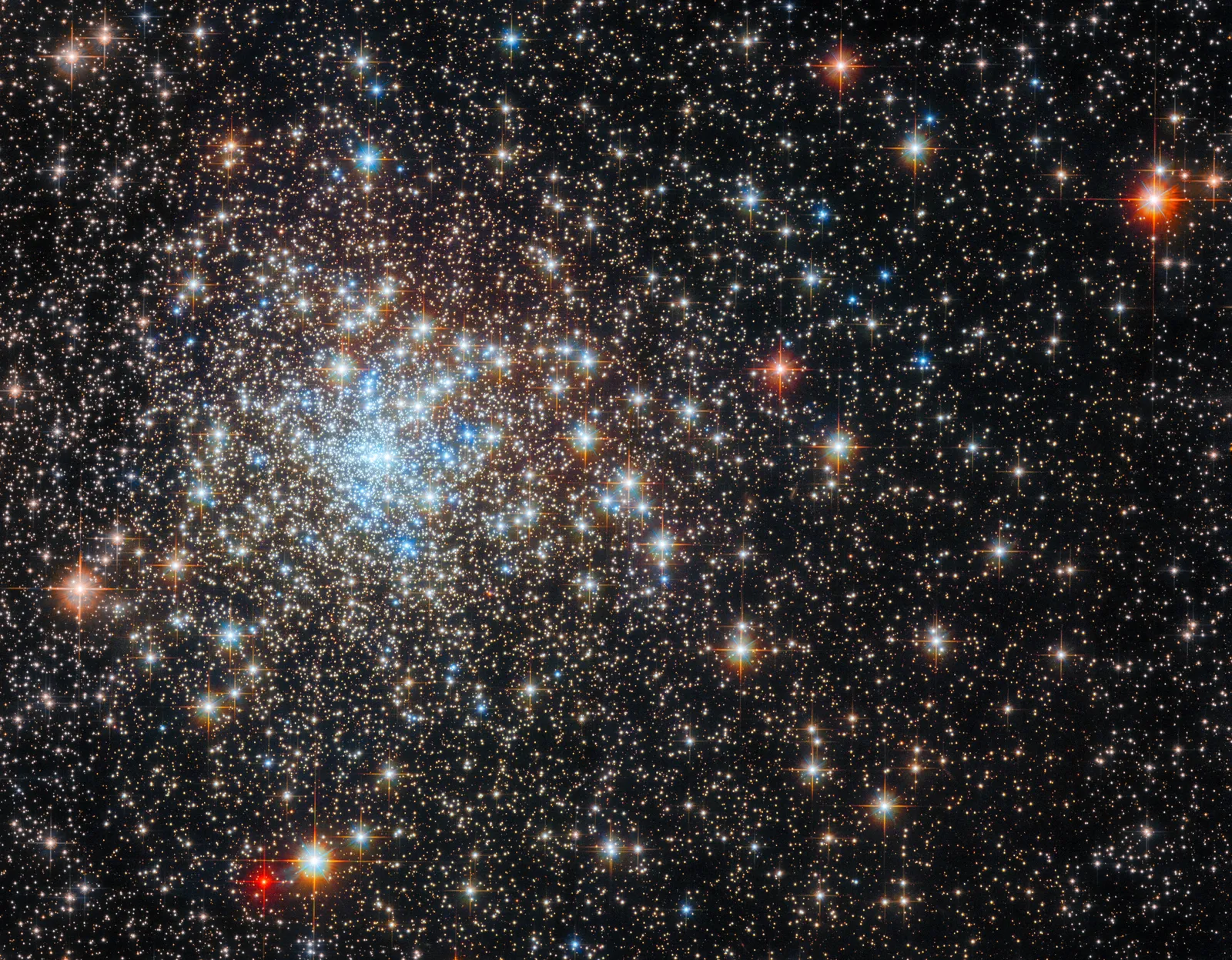
Black holes usually form with almost no rotation. A new study suggests that mergers of massive stars in dense clusters can spin them up substantially.
The authors analyzed roughly 150 star cluster models built with the Cluster Monte Carlo (CMC) code — a program that simulates the motion and collisions of stars using the N-body method. They searched for mergers of massive stars that end in black hole formation. Special attention went to "significant" events with a mass ratio above 0.1.
The idea works like this. During a merger, one star transfers angular momentum (its store of rotation) to another. Some merger products then evolve into objects with a thick accretion disk around the core. Such a disk can efficiently spin up the future black hole before the core collapses. The most promising CMC candidates were followed up with detailed MESA stellar evolution models.
For clusters resembling the globular clusters of the Milky Way, up to half of black holes may come from mergers. About 10% come from "significant" mergers. In some cases the dimensionless spin parameter reaches 0.5 or more, where 1 is the theoretical limit.
These are preliminary estimates for now. But if confirmed, spun-up black holes in clusters would become notable sources of gravitational waves.