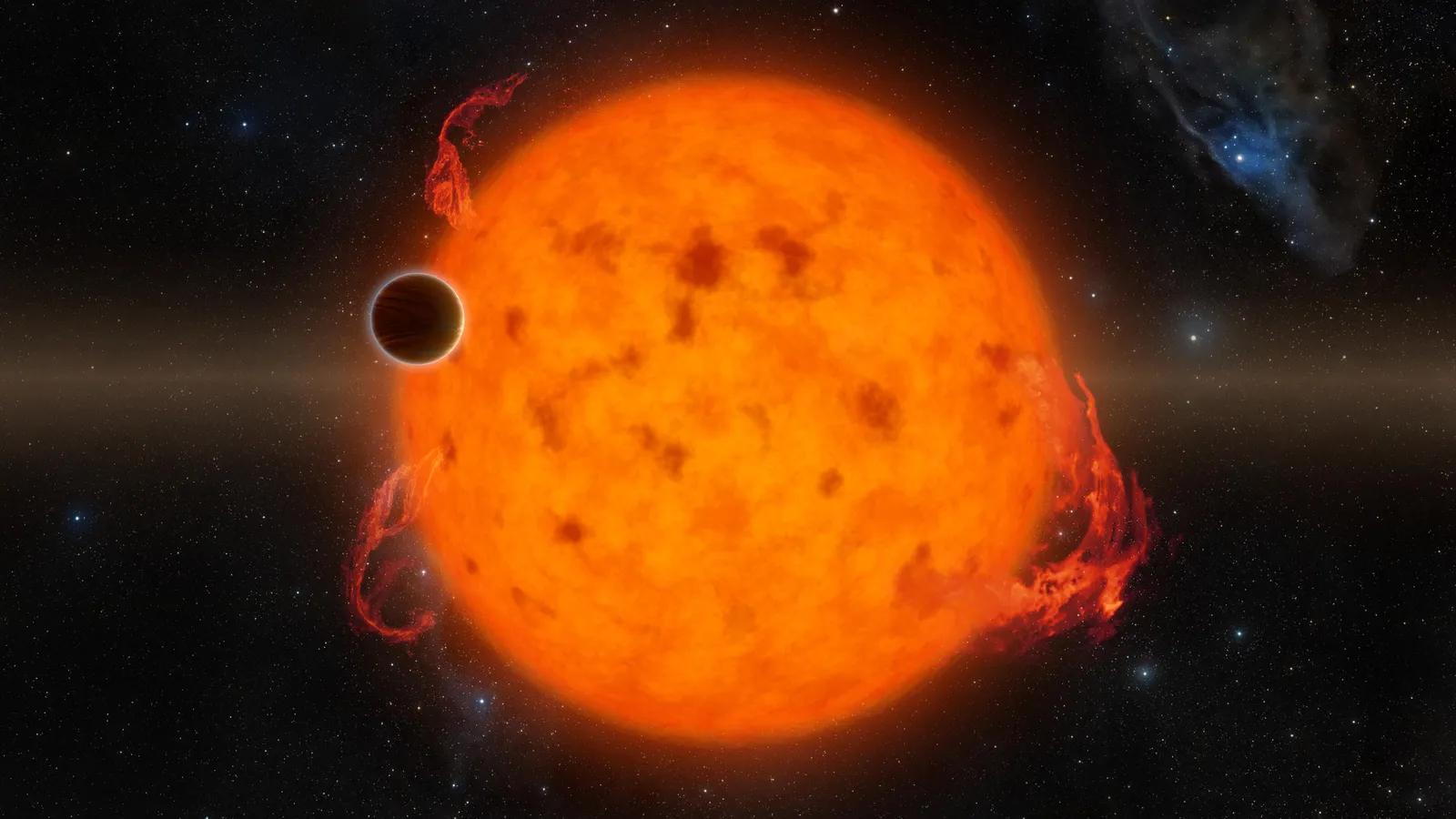
A system of at least two planets has been found around TOI-4311, an orange K-dwarf star. One of them is an ultra-dense super-Earth on a very short orbit.
The inner planet (labelled b) circles its star in under a day, with a period of about 0.99 days. Its radius is roughly 1.38 Earth radii and its mass about 4.5 Earth masses. That combination makes it very dense.
The second planet (c) is a sub-Neptune with a period of about 15 days and a radius near 2.47 Earth radii. It was first spotted by the TESS telescope through transits across the star. The CHEOPS satellite and the HARPS spectrograph helped refine the parameters.
The HARPS data also showed a third periodic signal that could not be tied to the star's own activity. It may point to a third planet with a period of about 38 days and a minimum mass near 26 Earth masses. But no transit has been found for it yet, so it remains unconfirmed.
The most intriguing part is the density of planet b. Given the star's chemistry and its motion between the Galactic thick disc and the Hercules stream, such a density is not expected. This means the system may contradict current planet-formation theories and reveal how the process differs across the Galaxy.