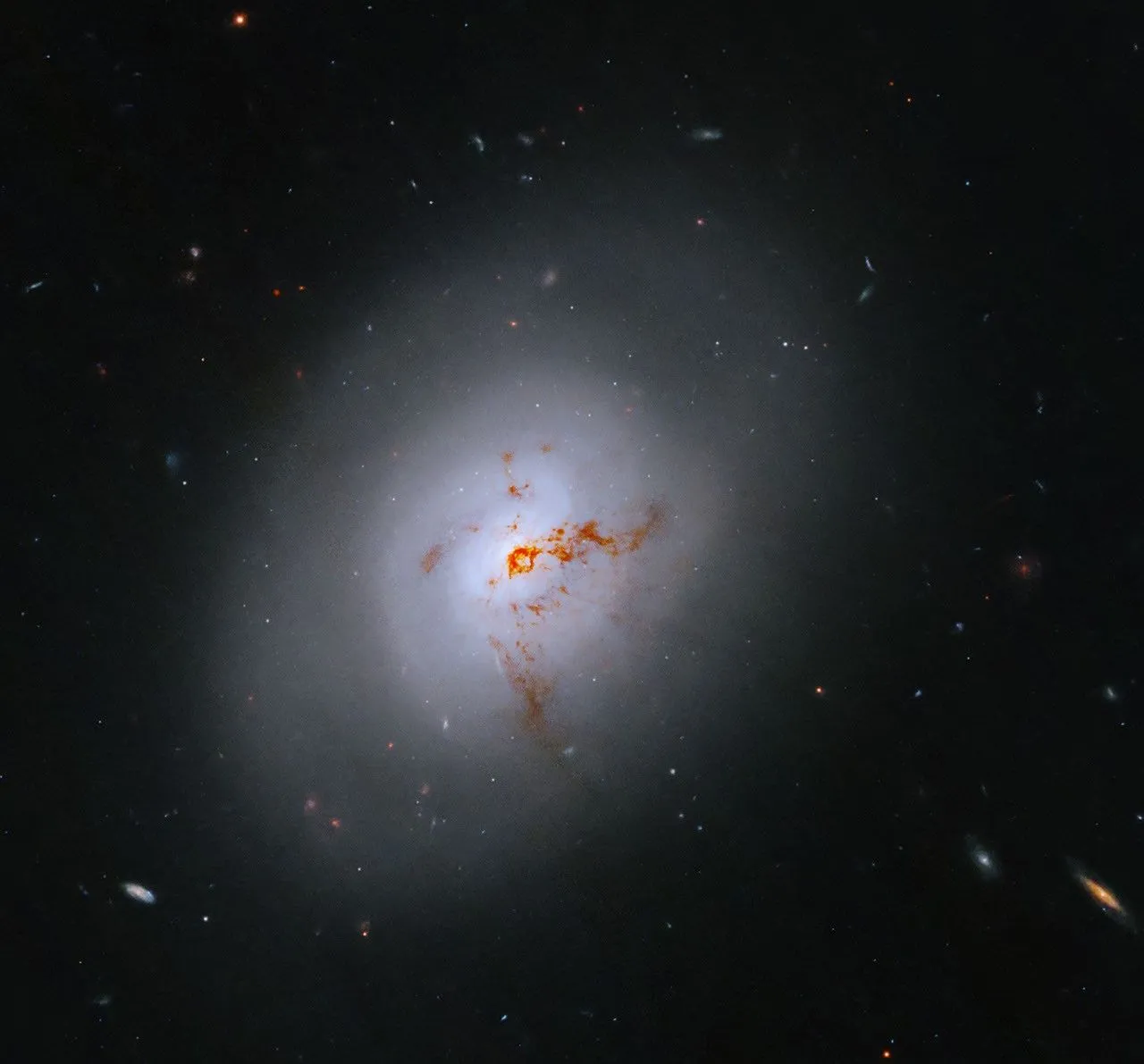
A new Hubble Space Telescope image reveals the lenticular galaxy NGC 1266, located about 100 million light-years away in the constellation Eridanus. At first glance it hints at spiral structure, but there are no spiral arms. It's a lenticular galaxy — a transitional type between spirals and ellipticals. It has the bright central bulge and flat disk of a spiral, but the armless, quiet nature of an elliptical.
The real intrigue: NGC 1266 is a rare post-starburst galaxy — roughly 1% of the local galaxy population. These are galaxies that recently experienced a powerful burst of star formation but are now "settling down" into a quiet elliptical state.
About 500 million years ago, NGC 1266 underwent a minor merger with another galaxy. This triggered a wave of new star formation and funneled gas into the central supermassive black hole, making it far more active. The black hole began generating powerful jets and winds that gradually blew out the gas — the fuel for star formation. The turbulence from these processes prevents any remaining gas from condensing into new stars.
Hubble observations confirm that surviving stellar nurseries exist only in the galaxy's core, with virtually no star formation beyond it. Such galaxies are ideal laboratories for studying how supermassive black holes shape the evolution of their host galaxies.