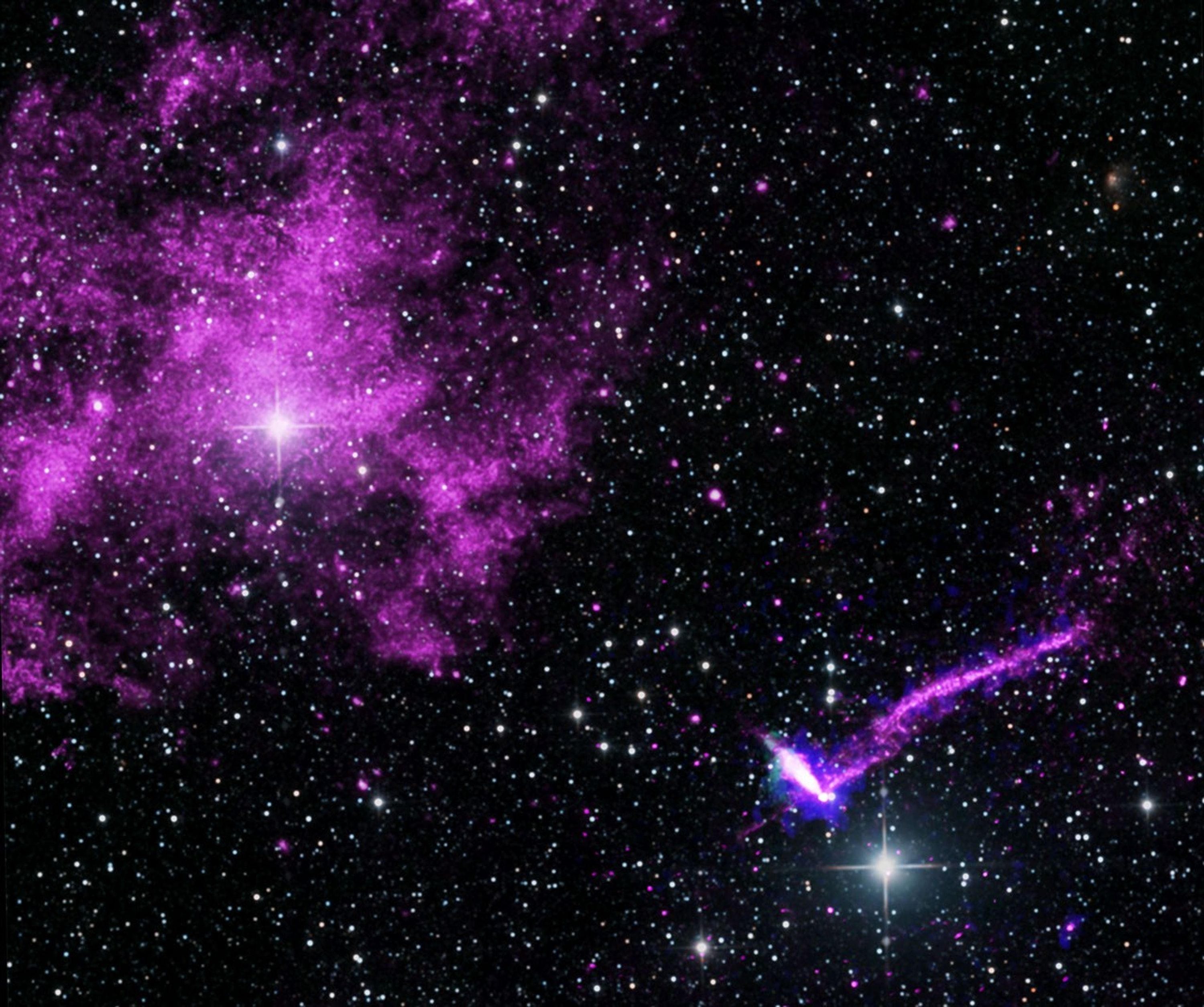
NASA’s IXPE space telescope has directly measured the magnetic field of pulsar PSR J1101−6101, in a nebula known as the “Lighthouse,” for the first time.
A pulsar is a type of neutron star with a strong magnetic field that spins very fast. This one rotates 16 times per second. The neutron star itself is the compressed leftover core of a massive star, heavier than the Sun but only the size of a city.
Astronomers studied two narrow X-ray offshoots extending from the pulsar. The longer one is called the “filament,” the shorter the “trail.” Particles accelerated by the pulsar to nearly the speed of light collide with interstellar gas and form a shock wave — like the wave at the bow of a boat. Most particles stay behind it, forming the trail.
Since 2008 researchers suspected that the highest-energy particles break through this shock and flow along the Galaxy’s magnetic field lines, creating the long thin filament. IXPE observed the nebula for nearly 18 days in June 2025 and confirmed with more than 99% confidence that the magnetic field does align with the particles’ flow.
But a new question emerged. The degree of polarization was higher than models predict, pointing to weaker turbulence than assumed. In addition, the radio-band magnetic field runs almost perpendicular to the X-ray one. According to the researchers, this is the first clear sign that particles of different energies occupy distinct regions of the system, possibly driven by different acceleration mechanisms.